
Two 80 kW chargers need 200 kVA. On a package substation that is a 2.5-tonne steel box, a concrete foundation and a crane. On poles it is two wooden cases and a local erector — and about half the money.
A charging site with two 80 kW DC units draws 160 kW. Allowing for power factor and conversion losses, the transformer is 200 kVA. Quoted as a package substation — high-voltage compartment, transformer and low-voltage panel inside one enclosure — that comes to roughly USD 14,000–21,000 of equipment, plus a foundation, a cable trench and a crane.
The alternative we build for export sites is a pole-mounted platform: the same 200 kVA transformer on two poles, fed through drop-out fuses, with the metering and distribution cabinet hung underneath. Equipment drops to about USD 8,500–11,300, it ships in wooden cases rather than on a flat rack, and the site works with a boom truck instead of a crane.
The saving is real. It is also conditional, and the condition is not ours to decide. That is the part most quotes leave out.
Why a package substation costs more than the transformer inside it
In a 200 kVA package substation the transformer is around a third of the price. The rest buys things a pole platform does not need:
- A high-voltage compartment with a load-break switch or vacuum breaker, plus relays that have to be set and tested on site by someone qualified
- An enclosure rated for outdoor use — IP54, ventilated, often with lighting and anti-condensation heaters
- A foundation, cable trench, fencing and an earth mat
- Freight. A 200 kVA unit is roughly 3.0 × 2.2 × 2.5 m and 2.5–3 t: not a pallet, not a standard container load, and usually a flat rack or out-of-gauge booking both ways
None of that is waste. It is what you pay for a substation that can be inspected, locked and worked on indoors. The question is whether a two-charger site needs it.
What a pole-mounted platform actually consists of
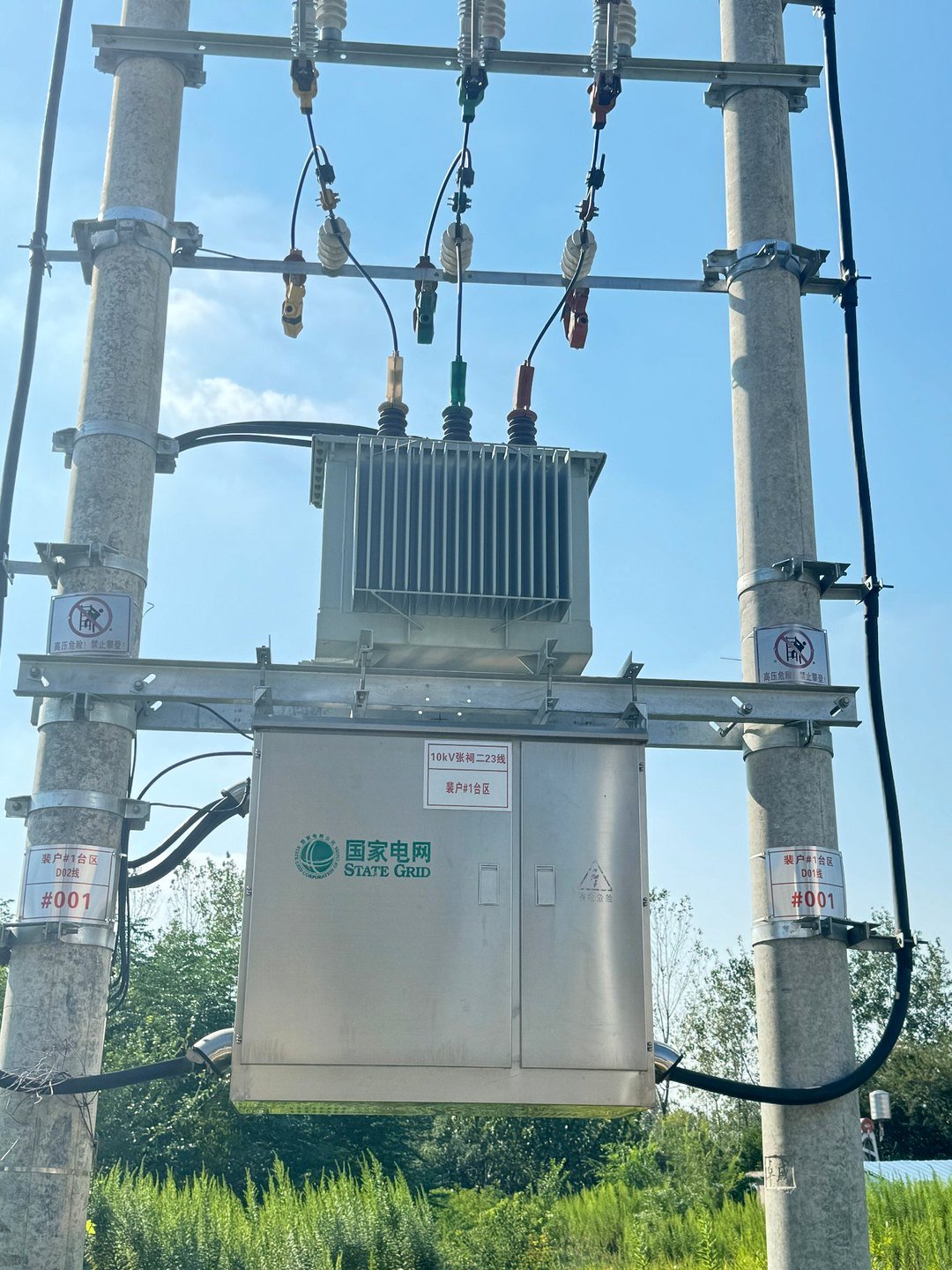
This is a product line we build, not an assembly put together on site. An oil-immersed distribution transformer sits on a steel platform between two poles; three drop-out fuses on the crossarm protect the primary, with surge arresters ahead of them; an integrated low-voltage cabinet hangs underneath, carrying the main breaker, metering, surge protection and the outgoing ways to the chargers. Add pole-line hardware — clamps, insulators, insulated conductors — and an earthing conductor down to rods at the base.
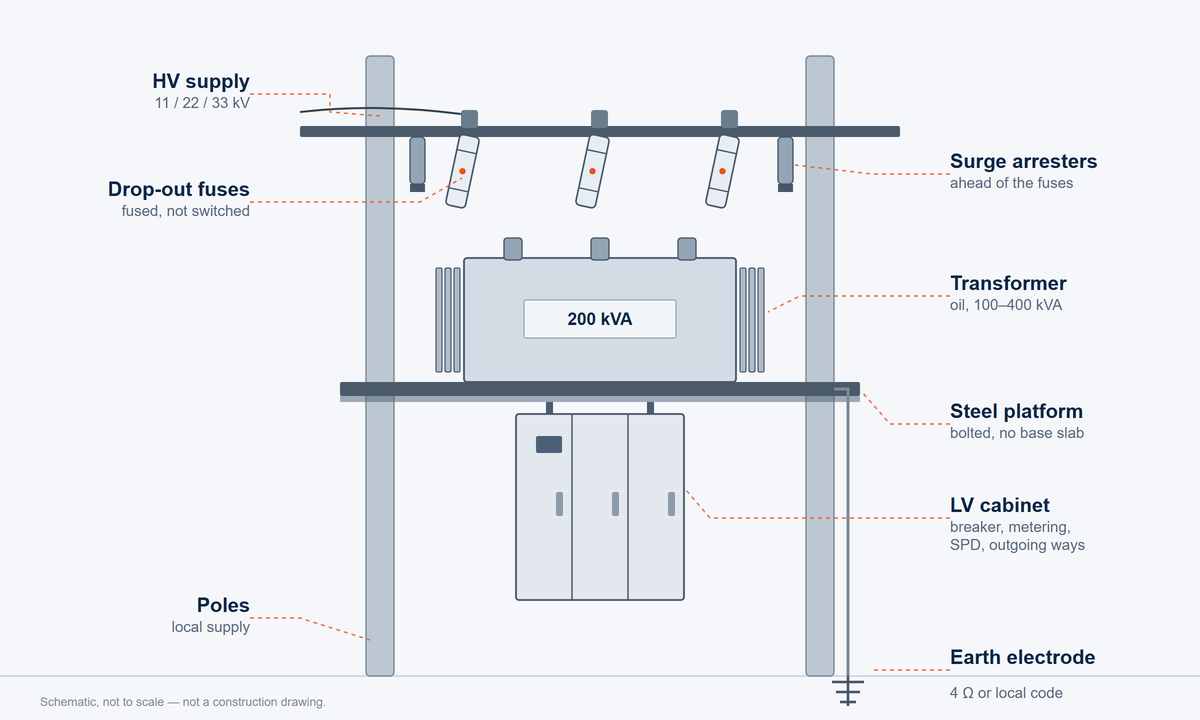
The poles are the one part we do not ship. Concrete or mild-steel poles are made almost everywhere and cost less locally than the freight on a single pole, so they belong in the local scope.
The cost comparison, at 200 kVA
| Package substation | Pole-mounted platform | |
|---|---|---|
| Equipment, ex-works | USD 14,000–21,000 | USD 8,500–11,300 |
| What the price covers | HV switchgear with relays, transformer, LV panel, enclosure | Transformer, drop-out fuses, arresters, LV cabinet, pole hardware |
| Left to the site | Foundation, trench, fence, crane, relay setting | Two poles, erection, earthing rods |
| Shipping | ~15 m³, 2.5–3 t, flat rack or out-of-gauge | ~4 m³, 1.5 t, two or three wooden cases, LCL |
| Typical lead time | 35–45 days | 25–30 days |
Two things make the gap wider than the equipment line suggests. Freight on a package substation is charged by volume and often by out-of-gauge category, while the pole platform travels as ordinary cargo. And the package unit needs a civil works package that in most markets is quoted by a local contractor at a price that has nothing to do with ours.
The condition: your utility decides, not us
Nearly all of the saving depends on one answer: will the local distribution company accept a customer-owned transformer on poles at this location, at this rating, with drop-out fuses as the only high-voltage protection?
In China this is the standard arrangement — it is the State Grid typical design for suburban and rural distribution, which is why the hardware is cheap and the lead times are short. Elsewhere it is often not allowed. Utilities in the UAE generally require pad-mounted equipment inside a lockable enclosure; practice varies by region in Saudi Arabia; in several African and Southeast Asian markets the pole and the transformer must be utility-owned, and a customer-owned unit on a customer pole will simply not be energised.
Ask before you design, not after you order. If the answer is no, a package substation is not the expensive option — it is the only option, and the comparison above is irrelevant.
Where the platform stops being sensible
Above 400 kVA. Our platform line stops at 400 kVA. Not because a bigger one cannot be built, but because it stops being worth building: at 2.5–3.2 t the two poles have to carry the transformer, the wind load and the safety factor a utility will insist on, foundations get deeper and steel gets heavier, and that work eats the equipment saving. Almost everything we ship is 100–400 kVA.
When the fuse cannot be made to coordinate. A package substation protects the transformer with a breaker and relays. A pole platform protects it with a fuse, and the fuse has to do two contradictory things: ride through the transformer’s magnetising inrush — eight to twelve times rated current for about a tenth of a second — and still clear a fault on the secondary. The usual starting point is a K-type fuse at 1.5–2 times the transformer’s rated primary current, then checked against the upstream recloser curve. Choose it by rule of thumb and the site trips every time it is energised.
On a site with no lightning protection plan. Chargers are power electronics. A surge that a motor would shrug off will destroy a rectifier, and the arresters on the pole protect the transformer, not the charger. Put a Type 2 SPD in the LV cabinet, hold the earth electrode at 4 Ω or below or to whatever the local code requires, and bond the charger enclosure to the same electrode. On export charging sites, lightning damage and poor earthing are among the most common reasons a unit comes back to us for repair — and this is a component that costs a couple of hundred dollars.
Sizing: 160 kW of charger is not 160 kVA of transformer
Two 80 kW chargers at 0.95 power factor and 0.95 efficiency draw 160 ÷ (0.95 × 0.95) ≈ 177 kVA with both units at full output. A 200 kVA transformer leaves about 12 per cent, and that margin disappears as soon as the site adds lighting, a payment terminal or cabinet cooling.
So the number depends on how the site is operated, not on the charger nameplate. If both units will run flat out simultaneously, specify 250 kVA. If a load management controller caps total draw at 120 kW, 160 kVA is enough and the platform gets cheaper again. Because the fuse and the service cable are sized from the transformer, oversizing “to be safe” is how a project ends up paying for the cost it was trying to avoid.
One item we stopped quoting by default: reactive compensation
Most integrated distribution cabinets in China ship with capacitor banks, because they were designed for rural networks full of motors. A modern DC charger uses an active front end with a power factor near 0.99 and low harmonic current — there is almost nothing left to compensate, and the capacitors sit idle until they fail.
If the chargers are older six-pulse units, the problem is harmonic distortion rather than displacement power factor, and capacitors can make it worse by resonating with the supply impedance. Ask for the charger’s power factor and THD figures before accepting a compensation cabinet as part of the package.

What we need in order to quote one
- Primary voltage and tap range, and whether the local standard is 11, 22, 33 kV or 12, 24, 36 kV
- The utility’s rule on customer-owned pole-mounted equipment — a link to their connection guide is enough
- Simultaneous charging load, and whether a load management controller is part of the design
- Earthing arrangement (TN-S, TN-C-S or TT) and who owns the neutral-earth bond
- Metering: utility CT meter, operator sub-meter, or both
- Whether wood packaging must carry the ISPM 15 heat-treatment stamp — without it the container is refused at destination, and re-treatment on arrival costs more than the crate
Send the charger datasheet and the site single-line diagram, and we will size the transformer, select the fuse against your upstream protection and price both options side by side. If the utility will not accept poles at your site, we will say so in the first reply rather than after the order.