
A solid state transformer rarely fails because the switches are too slow. It fails because nobody has shown yet that it will still be inside its specification in year fifteen.
Anhui Changda Electrical Equipment Co., Ltd. and Xinhe Semiconductor Co., Ltd. signed a joint development agreement in Hefei on 17 June 2026 to design, build and validate solid state transformers (SSTs) for AI data centre power delivery. The programme pairs a transformer manufacturer with a silicon carbide device maker, and its first output is not a catalogue product — it is a validated reference design that can be type-tested.
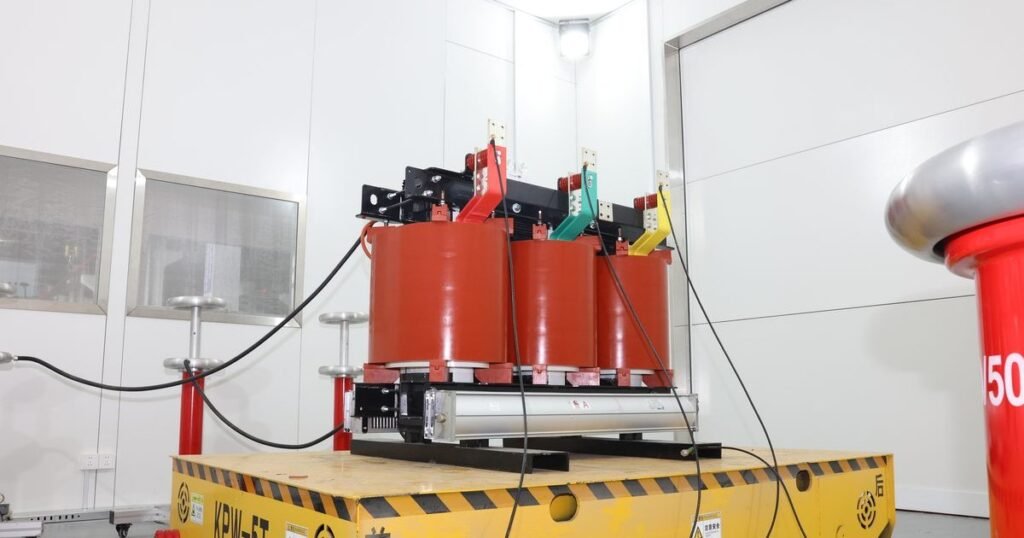
Changda has built oil-immersed and dry-type transformers, switchgear and packaged substations since 2011 from a 28,000 m² base in Hefei, and its testing laboratory already runs routine and type tests to IEC 60076. Xinhe Semiconductor is a silicon carbide IDM — chip design, wafer fabrication, packaging and testing — with devices from 650 V to 10,000 V and automotive-grade fabs in Beijing and Hefei.
| Agreement signed | 17 June 2026, Hefei, Anhui, China |
|---|---|
| Parties | Changda — transformer manufacturing, cabinet integration, test; Xinhe Semiconductor — SiC devices, PCB assemblies, control software |
| Scope | Joint design, build and validation of medium-voltage solid state transformers |
| First application | AI data centre power delivery, medium-voltage AC in, 800 VDC out |
| Later applications | EV charging, renewable integration, DC distribution |
| Primary market | Middle East, with Europe as the secondary focus |
What a solid state transformer does that a transformer cannot
A conventional transformer does one thing: it moves AC from one voltage to another at the grid frequency, and it does it for thirty years without being asked to think. A solid state transformer replaces that magnetic stage with high-frequency switching and high-frequency isolation, then adds active control on both sides. The output is not only a different voltage — it can be regulated, reversed, power-factor corrected, and delivered as DC.
That last point is why data centre operators are interested. The Open Compute Project’s SST Specification v0.3.0, effective 22 June 2026 and developed with Google, Microsoft and NVIDIA, defines the product around a 13.8 kV or 34.5 kV medium-voltage AC input, 5 MW or 10 MW of output, and an 800 VDC bus — with at least 98% power-train efficiency between 50% and 100% load, and tolerance of 150% overload for 150 ms. One cabinet replaces the medium-voltage switchgear, the line-frequency transformer, the low-voltage distribution and the rectifier stage.
The pressure is coming from the racks, not the grid
A hall designed for 10 kW racks and then filled with 100 kW racks runs out of copper long before it runs out of floor. Current falls in proportion to distribution voltage for the same power, so every step up removes conductor, busway and conversion loss from the chain. Moving to 800 VDC does exactly that — and pushes the conversion problem to the medium-voltage side, which is where a solid state transformer sits.
Policy is moving the same way. In March 2026 four Chinese ministries issued the Implementation Plan for High-Quality Development of Energy-Saving Equipment (2026–2028), which names large-capacity solid state transformers among the technologies to be promoted, and sets a target of more than 75% of newly added transformers being energy-saving units by 2028, with 15% of the installed base converted.
None of that makes the market mature. The OCP document is a specification, not a certificate, and publicly documented, fully commissioned SST installations in data centres are still counted on two hands. The gap between a converter that works on a bench and a product a facility team will accept is where most SST programmes have stalled — and it is the gap this agreement is aimed at.
Four problems that are not solved yet
- Die count. A 1 MW, 800 V design study by the UK’s Compound Semiconductor Applications Catapult found that the most efficient circuit layout still needed 288 silicon carbide dies per system, with 3.3 kV devices outperforming both 1.2 kV and 10 kV on efficiency. The arithmetic behind that is unforgiving: the highest-current die available falls from roughly 202 A at 1.2 kV to 52 A at 3.3 kV and 20 A at 10 kV, so a higher blocking voltage means fewer devices in series and more in parallel. Cost per megawatt is set by that trade, not by the price of a single switch.
- Component life against a 30-year asset. A distribution transformer is expected to serve 25 to 30 years with an oil sample every few years. An SST carries DC-link capacitors, gate drivers, fans and a control board. Capacitor life is quoted in thousands of hours at rated temperature and roughly halves for every additional 10 K, so a hall at 40 °C ambient with a 15-year design life is not a like-for-like replacement for a sealed tank. Either the capacitor bank is specified for the life of the asset, or the cabinet is designed so it can be replaced — and that decision changes the layout.
- Light-load efficiency. The 98% figure in the OCP specification applies between 50% and 100% load. Data centres spend much of their working life below that. A 10 MW unit running at 2 MW is the case worth asking about, and it is the number suppliers rarely publish.
- Standards and protection. IEC 60076 describes oil-immersed and dry-type transformers; it does not describe a converter with a transformer inside it. There is no product-level type-test standard for an SST yet, which means the buyer writes the test programme. Protection coordination, arc-flash energy, insulation coordination at the medium-voltage interface, and what the unit does when one power module fails all have to be agreed project by project.
For the next few years the honest reading is that solid state transformers will land first where the conventional alternative is expensive: electric vehicle supercharging, data centre halls designed for 800 VDC from the start, DC industrial distribution, and shore power. They will not replace the ordinary 10 kV distribution transformer in the near term, and a supplier who says otherwise is offering a story rather than a specification.
Who does what
The agreement divides the work along the lines the two plants are already set up for.
| Xinhe Semiconductor | Project organisation and coordination; SiC MOSFET power devices; complete PCB assemblies; software and control algorithms |
|---|---|
| Changda | Hardware and electrical components other than PCBs; power module structural design; cabinet integration and assembly; test power supplies and test site |
The second half of that split is where these projects usually go wrong. A converter that works on a bench does not automatically survive a 40 °C hall, a shipping container and a maintenance technician with a torque wrench. Cabinet integration, thermal design, dielectric clearance, ingress protection and the as-built test record are manufacturing problems — which is why the programme is being run out of a transformer plant rather than a laboratory.
Five questions to ask any SST supplier
- How many dies per switch position, and whose are they? Supply risk and cost both live in that answer.
- What is the measured efficiency at 30% load, not the headline figure at full load?
- What is the DC-link capacitor life at my site ambient, and can the bank be replaced on site?
- Which standard was the unit type-tested to, and by which laboratory? “We comply with OCP” is not an answer; OCP publishes a specification.
- What happens when one power module fails — ride-through, derating, or a trip?
A supplier who answers all five with numbers is worth a site visit. One who answers three of them with adjectives is not.
About Anhui Changda Electrical Equipment Co., Ltd.
Changda is a manufacturer of power transmission and distribution equipment based in Hefei, Anhui. Founded in 2011, the company operates a 28,000 m² facility and produces oil-immersed and dry-type transformers, switchgear, packaged substations and ring-main units in the 10 kV and 35 kV classes, together with transformers for solar, wind and storage projects and AC/DC charging stations. It holds ISO 9001, ISO 45001, ISO 14001 and ISO 50001 certification, CE marking for transformers and State Grid supplier qualification. Company profile.
About Xinhe Semiconductor Co., Ltd.
Xinhe Semiconductor is a silicon carbide power semiconductor IDM covering chip design, wafer fabrication, packaging and testing. Its portfolio includes SiC SBDs, MOSFETs, junction field-effect transistors and all-SiC modules from 650 V to 10,000 V, supplied as discrete devices, power modules and application-specific power units. Website: en.xhpsemi.com.
Media contact
Jiang Song, Anhui Changda Electrical Equipment Co., Ltd. — jiangsong@cdpow.com. For technical enquiries about transformers, use the contact form.
Related reading: specifying a distribution transformer for a 50 °C ambient site; ONAN versus ONAF cooling, and which one you can maintain.